
Using Population Projections for Policy and Planning Purposes
fast demography requires a new approach

As the saying goes, “If I had a dollar for every time someone said… “Population projections are always wrong”… I would have a lot of dollars…
This InSummary discusses the popular misunderstandings about population projections – what they are and what they are not and how to use them more effectively to plan for, and shape, a future reality.
Population projections V population forecasts
First, population projections are not forecasts. In the most traditional sense, population projections are official data produced by government statistical agencies.
In Australia, population projections are produced by the Australian Bureau of Statistics after each Census of Population and Housing, so, every five years. Projections estimate the future population size, growth rates, age and sex composition and spatial distribution – by state and territory.
In Tasmania, the Department of Treasury and Finance produces population projections at the Local Government Area (LGA) level, also after every Census.
Population projections look back to look forward. That is, the producers of population projections make assumptions about demographic variables (births, fertility rates, deaths, life expectancy and in- and out-migration by age and sex) based on recent trends identified through analysis of the Census data as well as administrative data sets like Births and Deaths Registers. They then make judgements about whether or not these patterns or trends will continue. Essentially, population projections are a statistical extrapolation of past trends which provide an indication of what is likely to happen if assumptions informing the projections hold true (i.e. that the recent trends informing the assumptions do not deviate).
Population projections usually produce at least three series (high, medium and low) with the medium series considered to be the most likely while the high and low series are usually considered ‘plausible’.
Forecasts on the other hand, can include assumptions about what may happen in the future and may also use non-demographic variables such as economic growth or land use changes or changes in household composition. Forecasts are usually commissioned. Forecasts are good for scenario planning and incorporating changed policy positions (as the Australian Government’s Centre for Population does in its annual Population Statement).
Population projections provide a really critical insight into what is likely to occur for a population if nothing much changes.
Demography and population projections
The thing is, population is not a fixed variable, and it doesn’t change at a linear rate. Demographic change is complex and influenced by a range of demographic and non-demographic variables and their interaction. Plus, humans are complex beings!
Demography isn’t intended - and is not able to - provide a crystal ball into the future and does not predict what will happen into the future. Demography is a social science which aims to understand human populations, human behaviour and predict, project or forecast change as well as the well-being of a population. Through data, demography provides informed foundations for decision-making and planning for the future.
The reality is that population projections are not intended to be right or wrong, but to provide an insight as to what would occur for a population into the future under certain circumstances. Importantly:
• Population projections will only be as good as the data being inputted and the level of understanding about the relationship between the components of population change and other parameters which influence human behaviour.
• Short term projections are much more likely to be reliable than longer term ones because small errors in assumptions can magnify greatly over time.
• Projections often influence action so that future population change will potentially be different, or even very different.
• Human behaviour is complex and increasingly heterogenous.
• Predictions about the future don’t eventuate because we don’t fully understand why what is happening is happening.
• If a particular projection does not transpire it is because the population and its components have stopped following that trend (i.e. the assumptions no longer hold true).
Fast V Slow demography
In the past (last Century in Tasmania) population projections were more ‘accurate’ and deviated less from the medium series. This was because the pace of demographic change was considered ‘slow’. That is, most (more than 60%) of the population change recorded by areas was driven by natural increase (more births than deaths). Given that the majority of the new population was aged zero upon their arrival into the area, planning for the new and growing population over their lifetime was more predictable and reliable. Economic and social infrastructure and services needs by age and stage was well understood and could be planned for in advance.
More recently (this Century) population change is dominated by ‘fast demography’. In Tasmania, more than 80% of population change is influenced by migration – either interstate or overseas migration. Migration is less predictable and much more volatile as it largely unregulated and is exposed to internal and external shocks (think pandemics, relative economic performance, housing, employment etc). It also comprises many forms. Migration can be any age or sex arriving or leaving the state to or from interstate or overseas. Migrants can be single, couples or families of almost any age or sex. Overseas migrants can be on temporary or permanent visas, working holiday makers, seasonal workers, students, visitors or Kiwis who have the right to reside in Australia, as do Australian in New Zealand. Overseas migrants can also be Australians who are leaving with the intention to live overseas for more than 12 months or returning after having left for more than 12 in the previous 16 months.
Migration is complex, more difficult to predict, and more vulnerable shocks. When population change is dominated by fast demography, producing population projections is more challenging, particularly for a medium to longer term period.
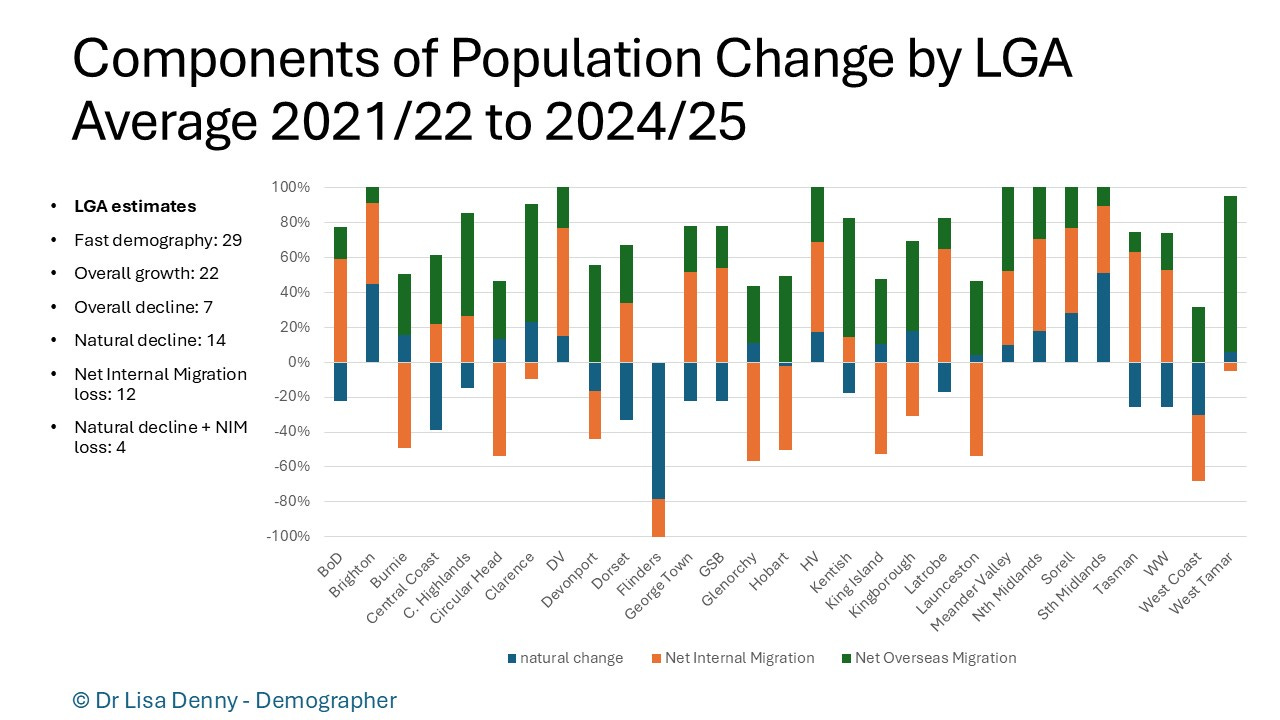
In Tasmania, on average over the past four years, all 29 LGAs experienced fast demography. For 22 LGAs, more than 75% of their population change was dominated by migration. For some, migration offset natural decline (more deaths than births). For seven, migration was not sufficient to offset natural decline.
Using population projections in a time of fast demography
Given Tasmania and its LGAs are experiencing fast demography, how population projections are used to inform policy and planning decision-making needs to evolve.
This starts with a much greater understanding of changing population dynamics and the six components of population change as per the population balancing equation: births, deaths, internal migration arrivals, internal migration departures, overseas migration arrivals and overseas migration departures, for the population of interest.
By understanding which of the components of population change has the greatest impact on overall population change, and why, greater insight into shaping a desired future population is possible.
The key components to achieving demographic resilience – that is a predictable and sustainable future population -, are to:
• Understand changing population dynamics
• Predict demographic change
• Understand the implications of the change
• Develop informed policy responses
• Proactively shape, strengthen and sustain economic and social systems over the longer term
• Continue to adapt to changing population dynamics
This requires on-going tracking and monitoring of population change against the population projections (and any forecasts commissioned), by component of population change.
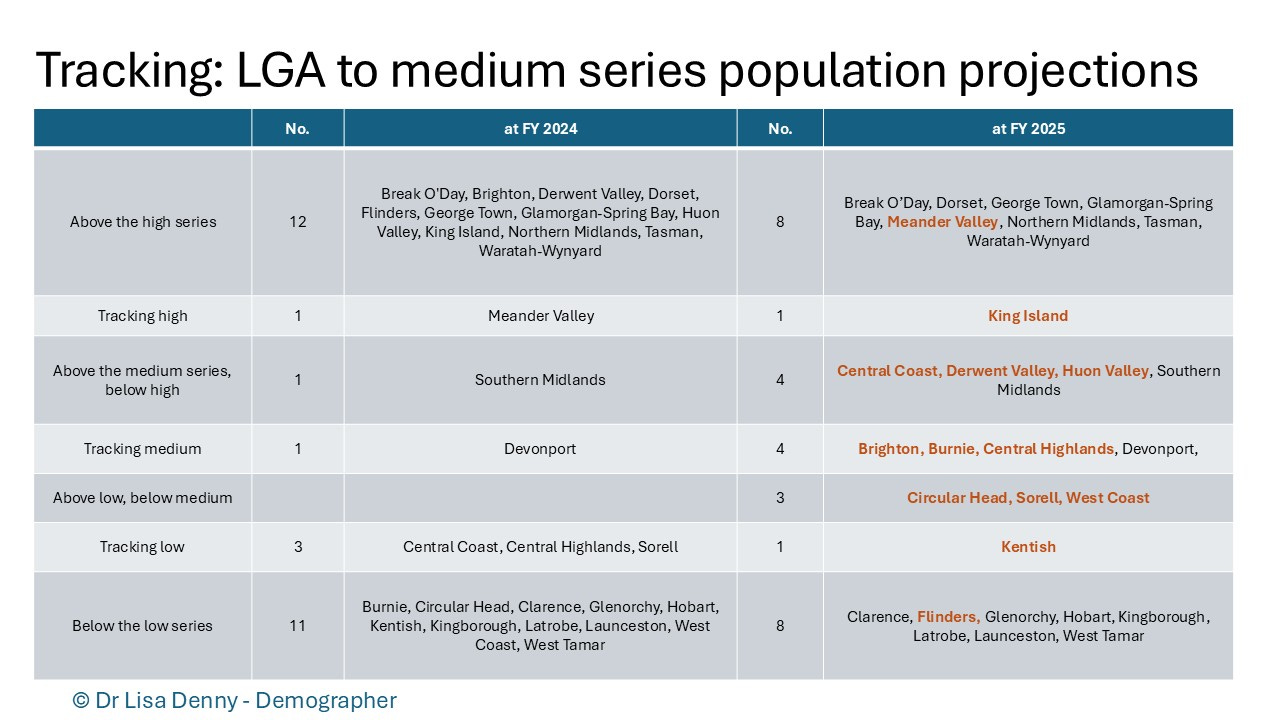
NB - For Orange indicates movement from previous year tracking.
InSummary
While there is the possibility to influence and shape future populations, it is also important to understand that demographic change is incremental in time, and dramatic over time. That is, change takes time, usually generations, even under fast demography circumstances. For that reason, population projections remain critically important for informing decision-making for policy and planning purposes. It is important to plan for your projected population while also simultaneously shaping a desired future population.