

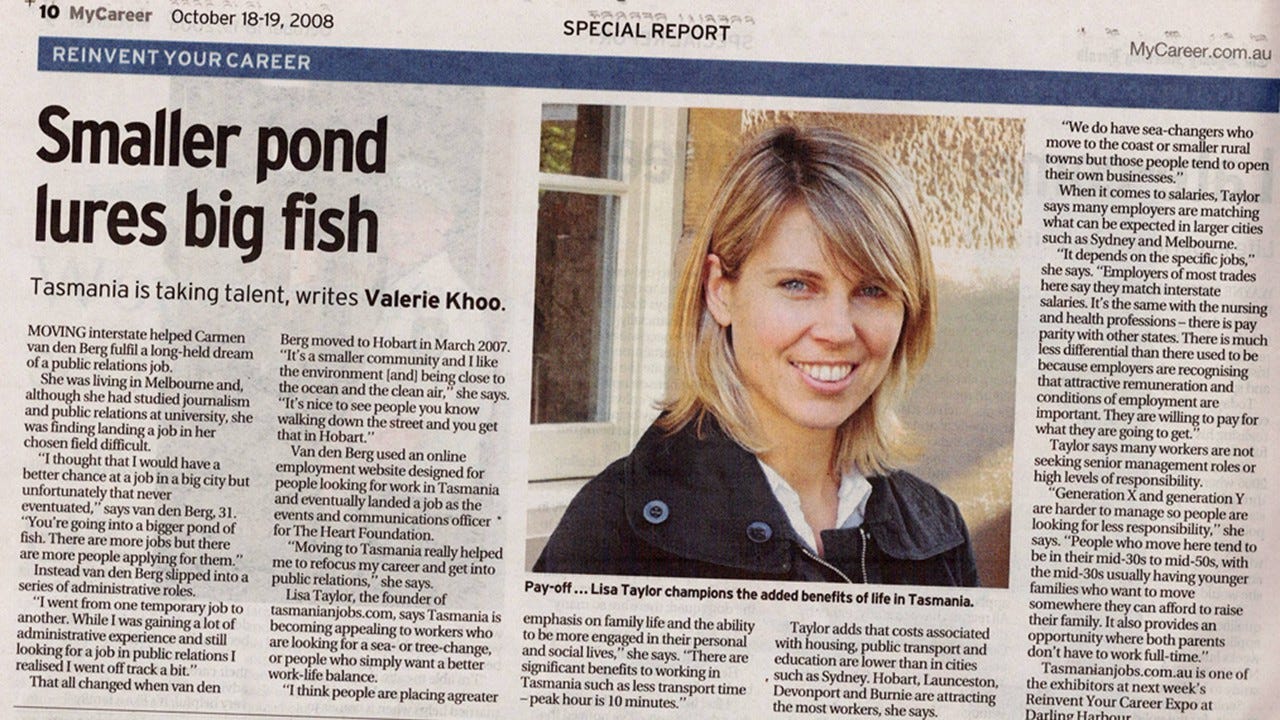
Twenty years ago this week, I launched my first business – tasmanianjobs.com – an employment advertising website. At the time, Tasmania was experiencing both strong economic growth and population growth, however, skill and labour shortages prevailed.
It was also a time of technological transformation and the dot-com boom.

All of a sudden, Tasmania was more visible to the rest of Australia and beyond. Real estate websites provided insights into our housing market, tourism websites visually communicated our unique experiences, brand and produce websites distinguished our clean, green produce and services and social media was born (remember myspace?).
Not only was Tasmania increasingly more visible, the introduction of low-cost airlines enabled the accessibility of Tasmania’s relative opportunities.
Also during this time, the first children of the post-World War II era began reaching ‘retirement age’ – 55 being the age at which superannuation was accessible and convertible to a lifelong income stream (for those on defined benefit schemes). Accumulated housing wealth enabled ‘mainlanders’ exiting the workforce to ‘seachange’ or ‘treechange’ to Tasmania with its enviable lifestyle and relative housing affordability.
Combined, all these factors contributed to stimulating Tasmania’s economy as well as growing (and ageing) Tasmania’s population.
In launching tasmanianjobs.com, I aimed to achieve three things:
1) Communicate employment opportunities in Tasmania in addition to the traditional avenues such as the (expensive) print media
2) Attract appropriately skilled and experienced people to pursue career opportunities in Tasmania
and, 3) Change the perception of Tasmania’s employment landscape, and, possibly indirectly, a fourth – to provide work and career aspirations for Tasmanians.

My consulting and research services grew alongside tasmanianjobs.com, particularly in relation to the nexus between education and training and workforce participation, planning and development.
Somehow, I also became a public voice for improving educational outcomes in Tasmania through keynote presentations (my first at the inaugural Skilling Tasmania conference in 2007) and the media.
(Side note - interesting that in this keynote I refer to the 1997 Nixon Report that determined Tasmania’s poor economic performance was the result of critical problems in five main areas; governance, government finance, education and training, industry development and planning processes).
To meet the growing skill and labour demand associated with a strong economy and ageing population, Tasmania needed to improve both school retention and achievement. I was subsequently appointed an inaugural Director of the Tasmanian Skills Institute (an initiative of the well-intentioned but doomed Tasmania Tomorrow framework).
While tasmanianjobs.com did not survive the GFC (neither did the Tasmanian economy nor the TSI), I continued to provide research and consultancy services as well as pursuing formal qualifications in social ecology (demography) and, eventually, undertook a PhD, “Skill utilisation in Australia: a response to the proposed 3Ps solution to the implications of population ageing”.
To improve workforce participation and productivity as well as meeting the future needs of the changing nature work resulting from industrial and technological advancements and demographic change, Tasmania still desperately needed to improve both education and training participation and outcomes, so I remained committed to my advocacy efforts to achieve this.
I extended my education advocacy efforts to focus on literacy following the birth of my son and his (on-going) journey as a young person living with a range of disabilities in the Tasmanian education system.
Given his severe and complex communication disabilities, I found myself on a new learning journey to understanding cognitive science and the process for improving educational outcomes and successful school completion through improving language and literacy outcomes, particularly in primary school.
To support my son and expand my knowledge, I furthered my formal education in the Science of Learning and literacy instruction.
My advocacy efforts shifted to literacy instruction as the means to improving both aspiration and achievement in Tasmania’s education system.
While there has been a significant policy shift in relation to literacy instruction, there is still a way to go to achieve successful implementation and improving the long-term educational outcomes of Tasmanians (see here).
Which brings me to 2026.
It’s hard to believe it’s been twenty years since I launched tasmanianjobs.com and started this journey, but it is also hard to believe that it has only been twenty years.
As I reflect on the last twenty years and what has or hasn’t changed, as well as what I have learnt along the way, I am also contemplating ‘what next?’ as I approach another milestone in the coming months - 50 years on this planet.
All I can really say for sure is that technological transformation will dominate and demographic change will continue.
While I say that demographic change is incremental in time - a slow burn, it is dramatic over time. Given the increasing rate of change, and the complex dynamics of population change, its dramatic implications will become even more visible, particularly over the next 25 years.
As Mark Carney, Prime Minister of Canada, recently said in his speech at the World Economic Forum – nostalgia is not a strategy.
For Tasmania, the reality, and projected demographic reality, is very different to the perceived reality of many.
To paraphrase Carney for this context, “The question is not whether to adapt to this new reality [but predictable reality]. We must. The question is whether we adapt or whether we can do something more ambitious”.
Tasmania’s current reality, likely to continue under current policy positions, is:
An ageing demographic – structurally and numerically
Slowing population growth
Net interstate migration losses for children, families and young working and reproducing age cohorts
Projected natural decline by the end of this decade
Slowing overseas migration
A Total Fertility Rate equivalent to generation three-quartering, and predicted to continue falling
Persistent skill and labour shortages
Poor educational achievement
Fewer school enrolments and eventual school leavers
Low levels of labour force participation and productivity
Low productivity industry structure
And, like the Nixon Report determined in 1997 (nearly 30 years ago), Tasmania [still] has critical problems in five main areas; governance, government finance, education and training, industry development and planning processes.
I maintain, demography does not have to be destiny. We can shape our future.
Be brave. Be courageous. Be ambitious, Tasmania, in the most effective, evidence-informed ways possible.
For a comprehensive and thorough explanation of current and forecast demographic change for Australia, refer to the Australian Government’s Centre for Population 2025 Population Statement, I highly recommend it.
Thanks and acknowledgements: There are numerous people I would like to thank and acknowledge for their support, guidance, mentoring and friendship over the past twenty years. First and foremost, my parents, Hugh and Kaye, my sister, Anna, my husband, Dave, and my inspirational son, Rory, whose personal circumstances drive me to continue doing what I do. Next, the late (and great to me), George Chambers without whom I would never have had the courage to take the leap into the unknown and highly risky territory of being a young, blonde, intelligent Tasmanian woman starting a fledgling and innovative business. Then, Professor Natalie Jackson - demographer - inspirer, educator, mentor and friend. To the Tasmanian Maritime Network, and particularly the phenomenal women behind the scenes - I would not have survived the early days/years without your support, network and connections - Di Tompson, Jill Taylor, Geraldine Edwards, Christine Fuglsang and the wider Tasmanian branch of Women Chiefs of Enterprise International as well as Sue Hickey, Kate Smith, Terri Simpkin and Lois Ryan in the early days. James Cretan, Mike Brough, Keith Thompson, Ian Paterson from Skills Tasmania. Susan Banks and Brendan Churchill, my PhD buddies. The late (and great) Graeme Hugo AO, Jonathan Wood, Alison Taylor, Daphne Habibis, Can Seng Ooi and more recently Saul Eslake, Michael Rowan, Rosalie Martin and Becky Shelley - thank you all. x