Tasmania does not have a problem attracting people to move to the state, it has a problem keeping people here
Talking Point, The Mercury, 24 December 2025

Tasmania does not have a problem attracting people to move to the state to live, it has a problem keeping people here, particularly families and future families.
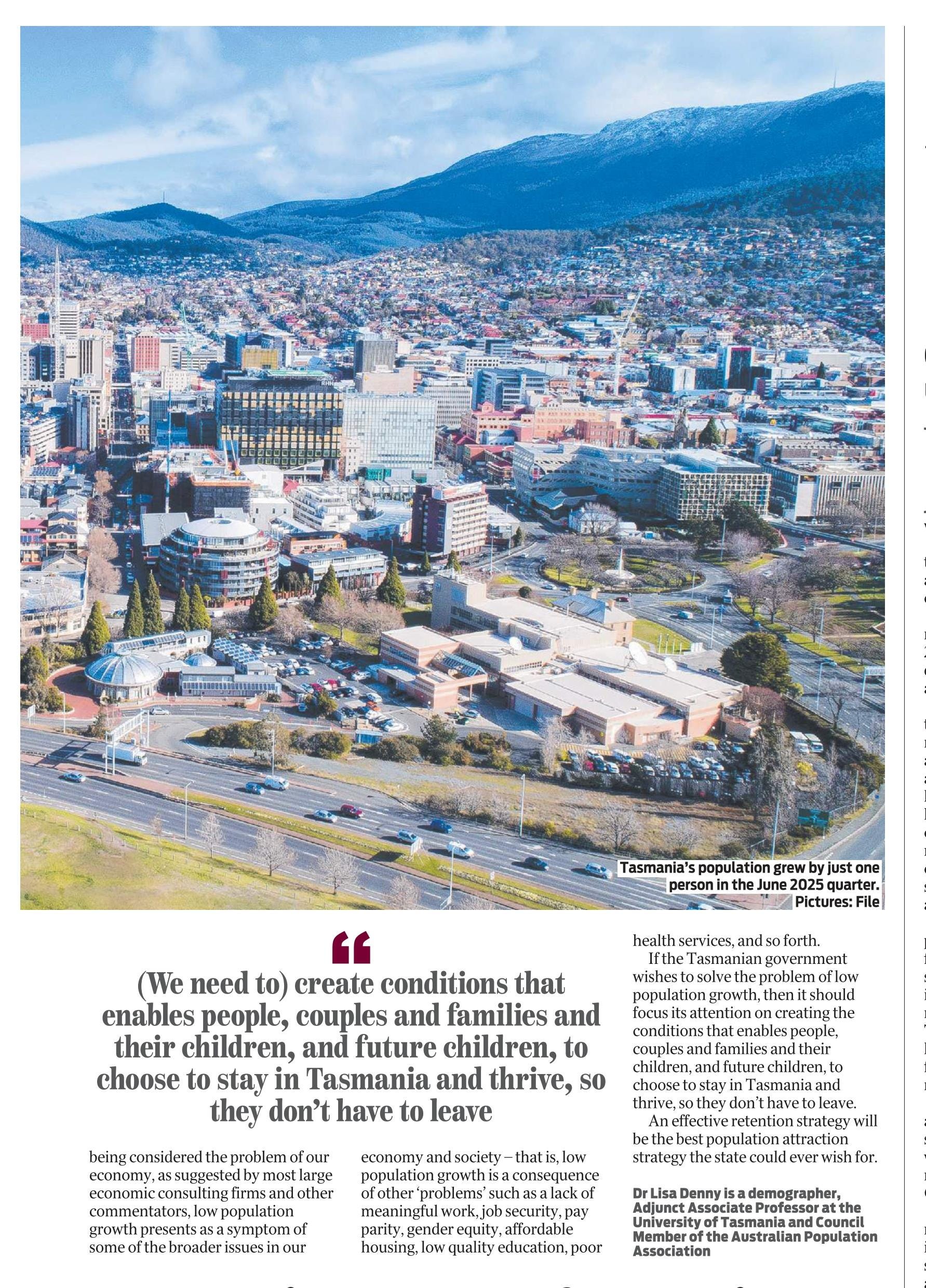
Population data released by the Australian Bureau of Statistics last month revealed that Tasmania’s population grew by one person over the June 2025 quarter, an annual growth rate of 0.2 per cent.
The primary cause of recent low population growth in Tasmania is the fact that interstate migration has been negative for three consecutive years. Net interstate migration losses result from more people leaving the state to live elsewhere in Australia than those who move to Tasmania to live. Interstate migration movements also have the greatest impact on Tasmania’s population age structure and long-term demographic change dynamics.
The thing about migration is that it is an expression of human freedom: agency and choice. For most, to be able to migrate is a privilege, for some, it is forced, or involuntary.
Over the last four years post COVID-19, thousands of people have moved to Tasmania to live - on average 13,533 each year. Many people choose to move to Tasmania – whether it be for the lifestyle and natural environment, to be closer to family, for work or education opportunities, to escape the heat or more volatile climates, or to retire. However, thousands more people choose to leave Tasmania to live elsewhere in Australia – on average 15,629 each year.
These people choosing to move to Tasmania do not offset all those who choose to leave Tasmania to live elsewhere. On average, net migration loss for the state is around 2,096 former Tasmanians each year.
Low population growth and the potential for future population growth is further impacted when interstate migration by age is considered. The reality is, despite claims that Tasmania is the best place to live, work and raise a family, more families with children are leaving the state than moving to Tasmania to live. Since 2021-22, there has been a net interstate migration loss for all age groups zero to 39 years, with the 30-to-34-year age group providing the greatest loss on average (803 per annum). Not only are these age groups of prime working age but they are also the prime reproducing age cohort. They are also choosing to live elsewhere.
As well as whole families, younger, working age people or couples who haven’t had children yet are leaving Tasmania and taking their future children with them. On average, over third of babies born in Tasmania each year are to mothers aged between 30 and 34 years of age.
In fact, the number of women aged 25 to 39 years – the age group to which 81% of all babies are born to in Tasmania – has declined over the last nine years (importantly this number also includes overseas migrants from which Tasmania has a net migration gain, however, who generally have lower fertility intentions).
Combined with Tasmania’s ultra-low total fertility rate, our current low population growth rate is also driven by less babies being born in the state because there are fewer women of prime reproductive age living in Tasmania.
Net overseas migration has returned to pre-COVID levels.
Rather than low population growth being considered the problem of our economy, as suggested by most large economic consulting firms and other commentators, low population growth presents as a symptom of some of the broader issues in our economy and society – that is, low population growth is a consequence of other ‘problems’ such as a lack of meaningful work, job security, pay parity, gender equity, affordable housing, low quality education, poor health services, and so forth.
If the Tasmanian Government wishes to solve the problem of low population growth, then it should focus its attention on creating the conditions that enables people, couples and families and their children, and future children, to choose to stay in Tasmania and thrive, so they don’t have to leave.
An effective retention strategy will be the best population attraction strategy the state could ever wish for.
Dr Lisa Denny is a demographer, Adjunct Associate Professor at the University of Tasmania and Council Member of the Australian Population Association
NB For those interested in climate-related migration in Australia, particularly in relation to Tasmania, this report released by Charles Sturt University last month is worth reading.